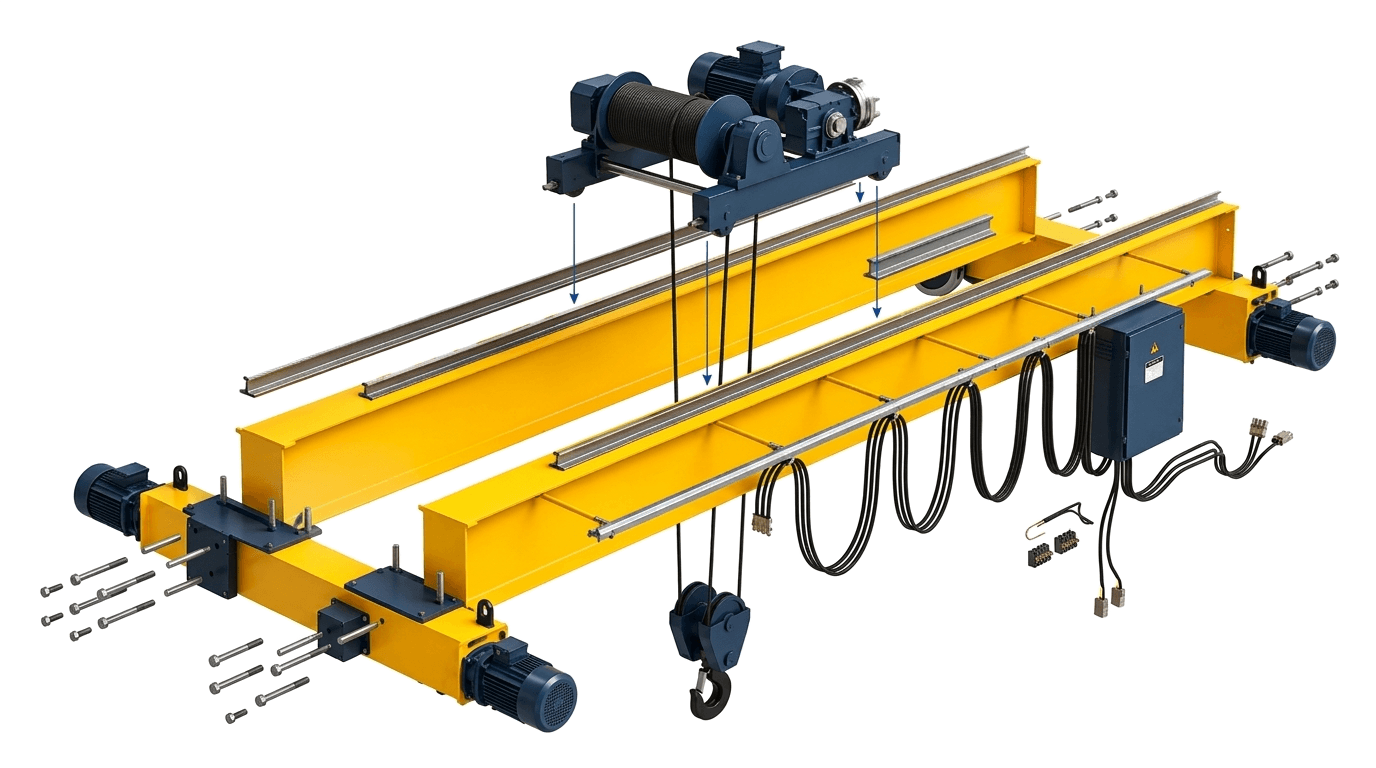
Single Girder EOT Cranes are optimal for capacities up to 20 Tons and spans up to 25 meters, providing lower building headroom requirements and reduced runway construction costs. Double Girder EOT Cranes are essential for heavy-duty applications (20 Tons to 125+ Tons), long spans (up to 40m+), high speeds, and severe duty cycles (Class M5 to M8), offering superior lifting heights as the crab trolley travels above the girders.
Key Takeaways for Engineers & Procurement Leads
- Single Girder cranes minimize building weight loads and cut initial capital expenditure by 18-25% for light-to-medium manufacturing.
- Double Girder cranes gain 1.2m to 2.5m in extra headroom because the wire rope hoist sits on top of the bridge girders rather than suspended beneath.
- IS 3177 / IS 807 design standards dictate duty classes from M3 (light workshop) to M8 (continuous 24/7 steel mill service).
- Induct Crane's Cloud ERP system provides buyers with real-time deflection test reports, ultrasonic weld inspection logs, and stage-by-stage fabrication tracking.
Selecting between a Single Girder and a Double Girder Electric Overhead Traveling (EOT) crane is one of the most critical capital expenditure decisions in industrial facility design. The choice directly influences building bay dimensions, runway beam sizing, foundation depth, power consumption, and long-term maintenance costs.
Structural Architecture & Hook Height Comparison
The primary structural difference lies in the placement of the hoisting mechanism relative to the main bridge girders:
- Single Girder EOT Cranes feature a single box or rolled beam girder. The electric wire rope hoist is under-slung, traveling along the bottom flange of the girder.
- Double Girder EOT Cranes feature two parallel box girders. The hoisting unit is mounted on a heavy-duty crab trolley that travels along rails welded to the top flanged plates of both girders.
Engineering Comparison Matrix: Technical Specifications
| Specification Parameter | Single Girder EOT Crane | Double Girder EOT Crane |
|---|---|---|
| Typical Capacity Range | 1 Ton to 20 Tons | 5 Tons to 125+ Tons |
| Maximum Economical Span | 7.5m to 25 Meters | 10m to 40+ Meters |
| Duty Class (IS 3177 / FEM) | M3, M4, M5 (Class 1 & 2) | M5, M6, M7, M8 (Class 3 & 4) |
| Hook Height Efficiency | Standard (Suspended Hoist) | Maximum (Top-Mounted Trolley) |
| Dead Weight on Runway | Lighter (Saves Shed Steel) | Heavier (Requires Heavy Runway) |
| Maintenance Access | Ladder / Portable Platform | Full-Length Walkway Platform |
| Auxiliary Hoist Option | Not Practical | Supported (e.g. 50T Main / 10T Aux) |
Duty Class Selection under IS 3177 & IS 807 Standards
Under Indian Standard IS 3177 (Code of Practice for Electric Overhead Traveling Cranes) and IS 807 (Structural Design), duty cycles are classified based on operating hours per day and load spectrum:
- Class M3 (Light Duty): Intermittent maintenance work, assembly shops with fewer than 2 hours of active lifting per shift.
- Class M5 (Medium Duty): General engineering plants, machine shops, and warehouses operating 8 to 16 hours daily at 50-70% rated loads.
- Class M7 / M8 (Heavy Duty / Severe Duty): Continuous 24/7 steel melting shops, foundry magnet applications, paper mills, and scrap handling where operations run constantly under maximum load.
How Induct Crane ERP Guarantees Fabrication Compliance & Outperforms Competitors
Traditional crane manufacturing often suffers from opaque timelines, unverified steel plate sourcing, and skipped non-destructive testing (NDT). Induct Crane System solves this by embedding every crane serial number into our proprietary Cloud ERP and Live Customer Portal.
"When you procure an Induct Crane, your project manager doesn't just send text updates — you log into your portal to view ultrasonic weld test certificates, steel mill test reports (MTR), deflection test videos, and live GPS transit tracking."
- Automated Stage Gates: Steel plate cutting, web-to-flange submerged arc welding, end-carriage alignment, and grit blasting each require QA sign-off in ERP before advancing.
- Digital Document Vault: Access CAD general arrangement drawings (GAD), electrical circuit schematics, and motor test certificates 24/7.
- 125% Dynamic Load Test Logs: Verified load deflection data stored permanently for annual factory inspector audits.
Induct Crane ERP Fabrication Intelligence
Unlike traditional crane vendors who offer zero visibility during manufacturing, Induct Crane System logs plate cutting, box girder sub-assembly, ultrasonic weld testing, surface blasting, and 125% load testing into your dedicated Customer Portal in real-time.
Questions Answered in This Guide
Q1.When should I upgrade from a Single Girder to a Double Girder EOT crane?
You should choose a Double Girder EOT crane if your required capacity exceeds 20 Tons, your building span exceeds 25 meters, your duty cycle requires M6-M8 continuous service, or if your facility requires maximum hook lifting height and a secondary auxiliary hoist.
Q2.How does Induct Crane ERP track crane manufacturing for client audits?
Induct Crane Cloud ERP assigns a unique project tracking code to your order. Clients can log into http://inductcrane.in/login or http://inductcrane.in/portal to inspect real-time manufacturing stage progress, mill test certificates, NDT weld reports, and live GPS delivery status.
Q3.What is the standard wheel load difference between Single and Double Girder cranes?
Single Girder cranes distribute dead weight across 4 wheels with lower maximum wheel loads, reducing runway beam structural steel requirements by up to 20%. Double Girder cranes feature 4 or 8 heavy-duty wheels designed to spread heavy tonnage evenly across runway girders.